Art Studio Tour
- mjboettcher
- Sep 2, 2021
- 2 min read
Updated: Oct 18, 2021
I was fortunate enough to be able to be apart of an art studio tour. It was an amazing experience to see! This is my story.
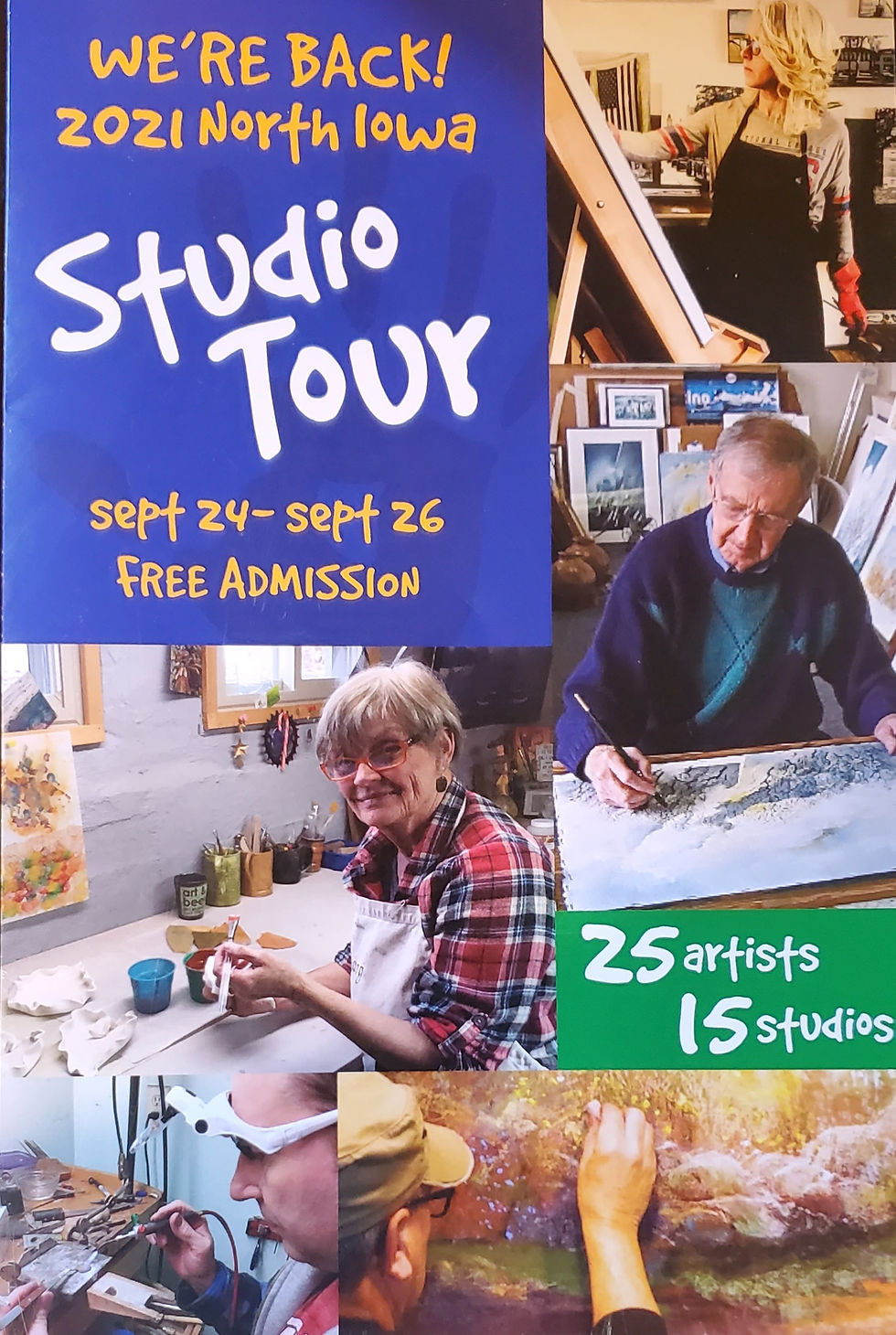
On Friday, September 24, 2021, I attended the studio tour in Mason City, Iowa. The first studio I stopped at was Richard Leet’s. Richard primarily uses watercolors and pastels in his paintings. He has paintings in his studio that date back to the late 1950’s. It was amazing to be able to see his transitions of art throughout the years. Through his art pieces you could see what he was going through at that time in his life. He was really excited to show some of his techniques that he used. In the one painting it looks like it is snowing. He uses his pallet knife to scrape little holes in the paintings to make it look that way. Before he started using this technique, he used salt to have a snowing effect. Then he would paint over the salt to make sure it would stay. When painting over salt, the color will not stick to the salt. This was something new I had learned and would never have guess that salt did not absorb color.
Another artist I saw was Karl Schilling in Manly, Iowa. He creates kaleidoscopes in his studio. I was able to talk with Karl for over an hour. He had given me so much information in the time that I was there. I am so thankful to have had that time with him. There are multiple different versions of kaleidoscopes. The two main ones you will see are two- mirror system and a three-mirror system. The two-mirror system will usually have more circle mandala images you see when you spin them. The three-mirror system needs a lot of light in the room for you be able to see the image clearly.
The mirrors used in the kaleidoscopes are called a first surface mirror. These mirrors define the image more and are not like your regular mirrors. The mirrors used at a register to scan items you are purchasing are the same type of mirror. They reflect the image in a way that a normal mirror does not. Karl uses a 1984 technology to be able to piece the kaleidoscope ends together. This is called a sonic welder. It might be a little bit of an older technology, but he found out that it is the best thing to work with. When he uses the sonic welder, he doesn’t have the problem of oil leaking from the kaleidoscope like he has in the past.
Karl also makes teleidoscopes, which has one lens at the base of it with an open view. You look through it and circle around the room to see different shapes. This one does not have shapes at the bottom of it for you to view. Karl will also make custom pieces for businesses or anyone who requests them. It was an amazing day and I learned so much from it.


Comments